5 Things That Actually Help When a Parent’s Hands Shake at Dinner
From cheap fixes to the one appointment most families skip — what works, what to watch out for.
When a parent’s hands start to shake, dinner quietly becomes the hardest hour of the day — and the internet’s answer is a wall of gadgets. After testing more of them than we’d like to admit (and talking with families living the same evenings we did), here are the five things that actually move the needle. Four of them aren’t even ours.
#1 — Weighted, bendable utensils
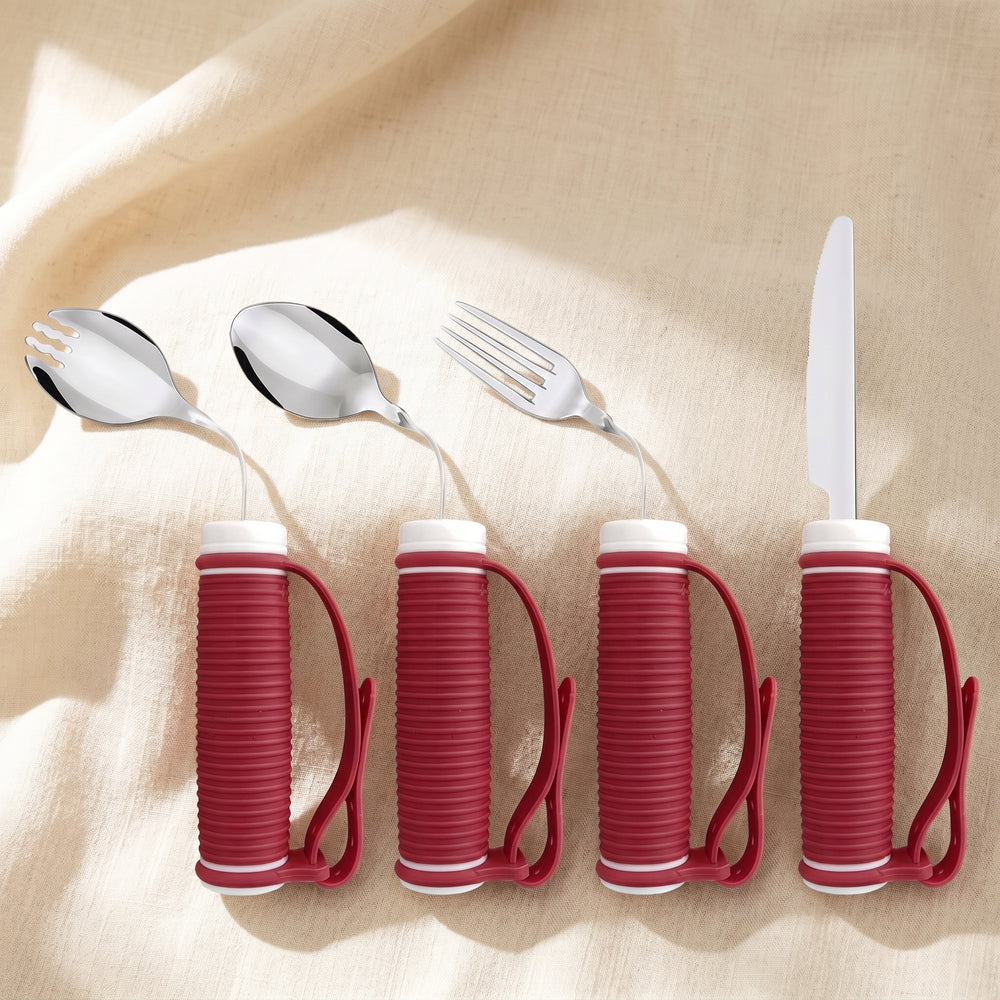
The physics first: ordinary utensils are thin and light, so a tremor amplifies on the way down the handle — like a camera with no tripod. Weighted utensils work the opposite way: the mass absorbs the shake before it reaches the food. The best sets add two more things — a bendable neck (so a stiff wrist doesn’t have to twist) and a wrist strap (so a weak grip doesn’t have to squeeze).
Ours — the Steady Adaptive Utensils ($99.95, free US shipping) — are built around exactly those three: 92–114 g weighted handles, 304 stainless heads, bendable spoon/fork/spork, rigid knife, adjustable strap. Backed by a 30-day guarantee where we pay return shipping if mealtime isn’t easier.
 See the Steady Mealtime Set →
#2 — A scoop plate or plate guard (~$15–25)
A raised inner edge gives food something to be pushed against, so it climbs onto the fork instead of off the plate. Small change, big drop in frustration.
#3 — A non-slip mat under the plate (~$10)
The cheapest fix on this list. A silicone mat stops the plate from wandering, which means one less thing the hand has to control.
#4 — A cup with a lid and handles (~$15–30)
Drinks usually spill before food does. A lidded cup with one or two big handles removes the most public spill of all.
#5 — One session with an occupational therapist
The professional move most families never think to make. An OT watches your parent eat and tailors everything — utensil weight, plate, seating, angles. Ask your parent’s doctor for a referral (often covered by insurance or Medicare with one).
The quick recap
| # | What | Solves | Typical cost |
|---|---|---|---|
| 1 ★ | Weighted bendable utensils | The shake itself | $99.95 |
| 2 | Scoop plate | Food escaping the plate | $15–25 |
| 3 | Non-slip mat | The wandering plate | ~$10 |
| 4 | Lidded cup | Spilled drinks | $15–30 |
| 5 | OT session | The whole picture | often covered |
1 ★ Weighted bendable utensils — the shake itself — $99.95
2 Scoop plate — food escaping the plate — $15–25
3 Non-slip mat — the wandering plate — ~$10
4 Lidded cup — spilled drinks — $15–30
5 OT session — the whole picture — often covered
Start with #1 and #3 tonight; book #5 this month.
Bring back the dinner table →A few quick questions
Do weighted utensils really help with tremors?
For many people with mild-to-moderate tremor, added weight visibly reduces spills at the first meal — weight absorbs shake the way a tripod steadies a camera. They’re daily-living aids, not a medical treatment.
How heavy should adaptive utensils be?
Around 90–115 g per utensil steadies most hands while staying comfortable to lift.
What helps severe tremors at mealtime?
Ask an occupational therapist; electronic stabilizing utensils ($195+) are the usual step up when weighted sets aren’t enough.